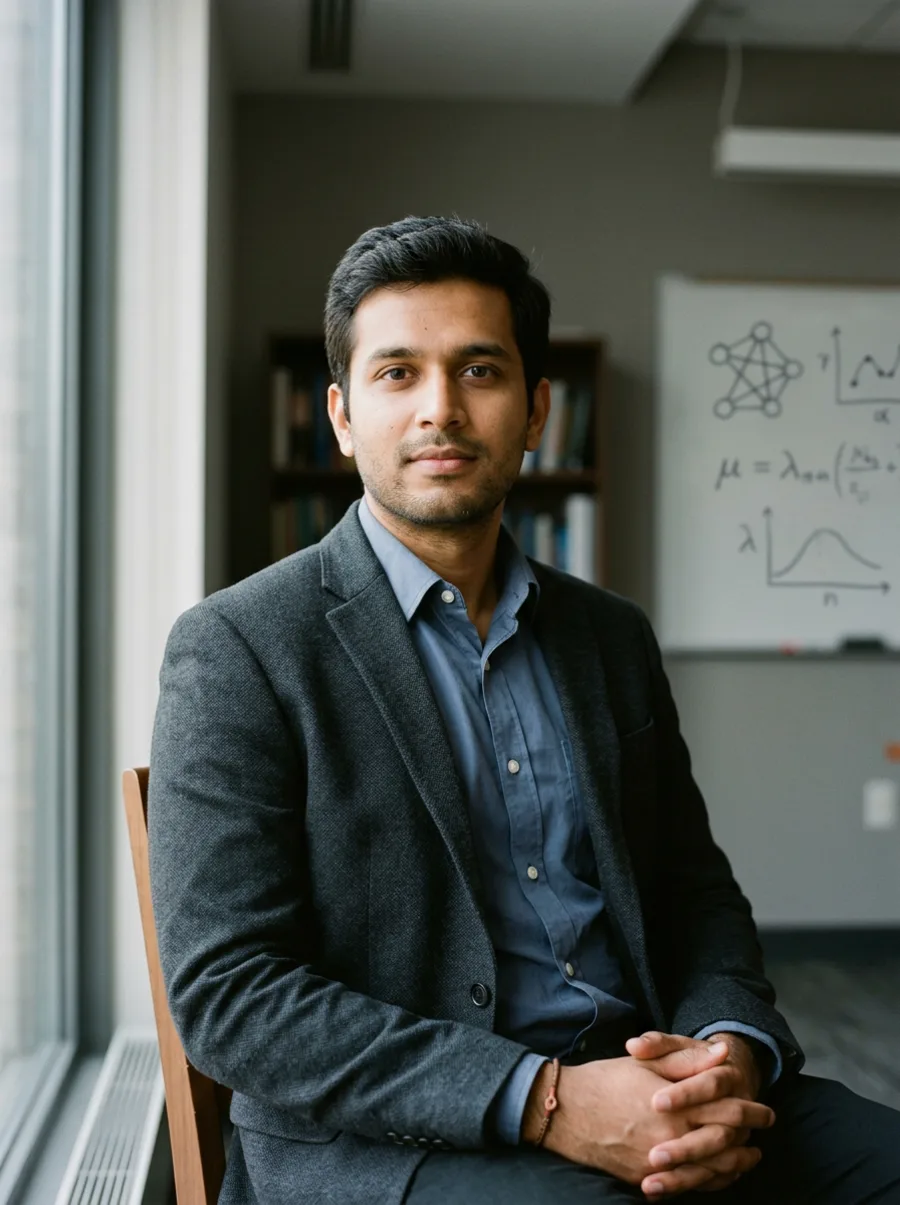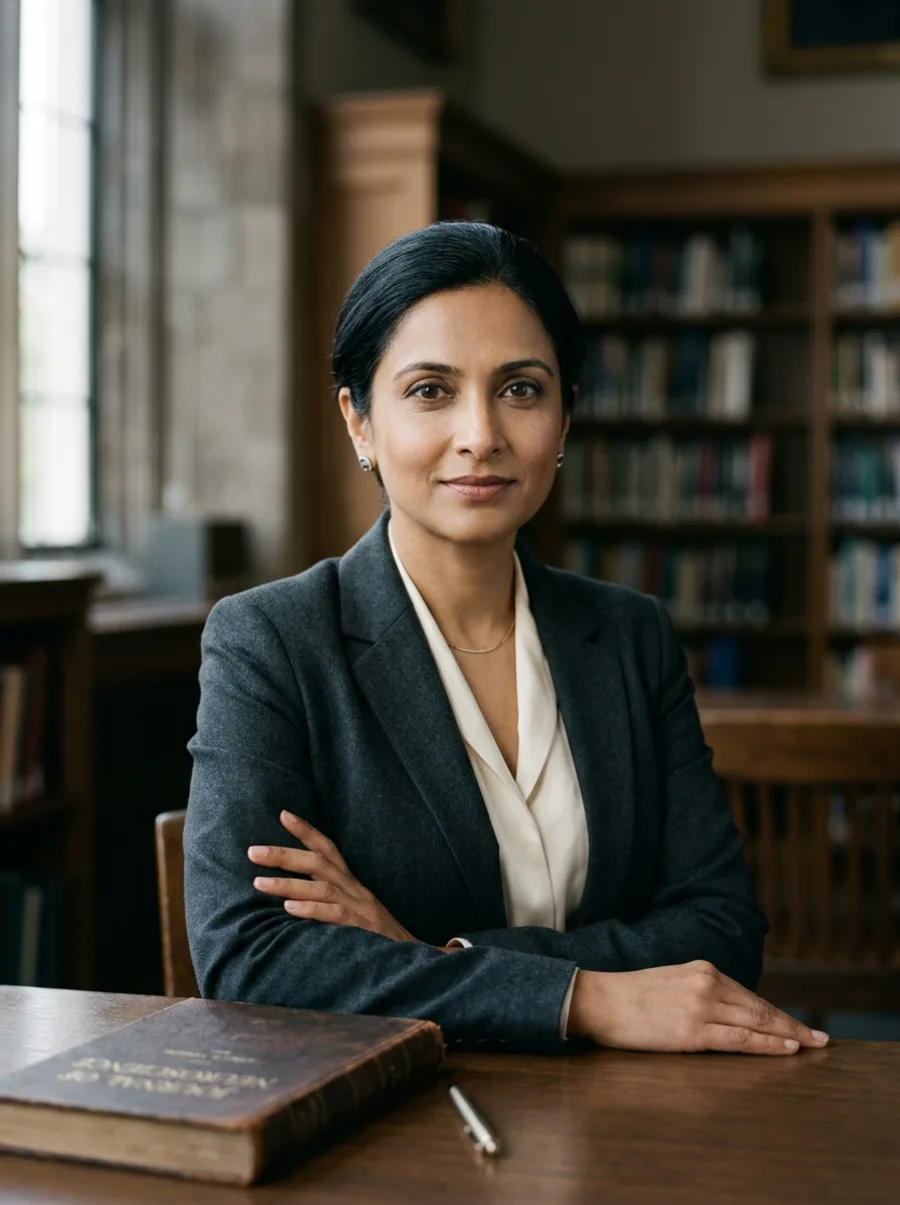
Portrait of Dr. Aditi Sharma Distinguished Researcher

Doctoral Achievement

Dr. Aditi Sharma, PhD

Senior Research Fellow in Computational Neuroscience

PhD in Computational Neuroscience

Location

Cambridge, United Kingdom

Published

September 05, 2026

Publication ID

ATR-2026-00476

Credential status

Institutional Reference

01 · Introduction

Academic journey

Aditi Sharma grew up in Pune in a household of physicians and was, by her own account, the disappointment who preferred mathematics. She took a bachelor's degree in electrical engineering at IIT Bombay before discovering, in a final-year project on signal processing for EEG data, that the two vocations were not in fact opposed.

Her doctoral work at Cambridge examined whether the fine temporal structure of neural recordings carries information about degenerative change long before that change becomes clinically legible. The question was not new. What was new was the availability of longitudinal datasets large enough to test it, and the willingness of her department to let a doctoral candidate spend eighteen months on data curation before producing a result.

That patience shaped her methodological convictions. She is unusually vocal, for a computational researcher, about the limits of retrospective validation, and her group now runs prospective studies in collaboration with three memory clinics — slower work, and considerably harder to publish.

She holds a joint appointment between the Department of Engineering and a clinical neuroscience unit, and supervises doctoral students from both.


The interesting cases are never the obvious ones. A diagnosis that arrives eighteen months earlier is a different disease, clinically speaking, than the same diagnosis arriving late. — Dr. Aditi Sharma · On the clinical value of early detection
02 · Qualifications

Academic credentials

2021

PhD in Computational Neuroscience

Longitudinal neural modelling

University of Cambridge · United Kingdom

2017

MPhil in Machine Learning

Probabilistic modelling

University of Cambridge · United Kingdom

2015

B.Tech Electrical Engineering

Signal processing

Indian Institute of Technology Bombay · India

03 · Research

Doctoral research

Research title

Temporal Signatures of Neurodegenerative Change: Longitudinal Modelling for Pre-Symptomatic Detection

Abstract

The thesis investigates whether high-resolution longitudinal neural recordings contain detectable signatures of neurodegenerative processes prior to clinical presentation, and develops modelling approaches suited to the small-sample, long-horizon structure of such data.

Problem statement

Diagnosis of several neurodegenerative conditions typically occurs after substantial and irreversible change. Existing predictive work relied heavily on cross-sectional data and retrospective validation designs vulnerable to temporal leakage, producing performance estimates that did not survive prospective testing.

Research methodology

A longitudinal cohort design combining EEG and structural imaging across 1,340 participants followed for a mean of 6.2 years, analysed using state-space models with subject-specific random effects. Validation used strictly forward-looking splits, with a pre-registered analysis plan and an external replication cohort held by a partner institution.

Major findings

Temporal features derived from resting-state recordings carried predictive information at a mean lead time of 19 months prior to clinical diagnosis, with performance substantially below that reported in retrospectively validated studies but stable under external replication. A secondary finding documented the mechanism by which conventional cross-validation inflates such estimates.

Academic contribution

The work provides a validated estimate of achievable diagnostic lead time under realistic conditions, and a methodological correction now adopted in several research groups.

Future applications

Prospective clinical studies with three memory clinics are examining whether the identified lead time translates into changed care pathways.

Supervisor
Prof. Helen Marsden
Department
Department of Engineering
University
University of Cambridge
Completion year
2021
04 · Bibliography

Publications

4 works recorded on this profile, as provided or externally referenced.

01

Journal Article

Temporal leakage in longitudinal neuroimaging cohorts: a systematic reassessment

Sharma, A., Marsden, H.

NeuroImage, 2024, Vol. 291, pp. 120–139

02

Journal Article

State-space modelling of pre-symptomatic neurodegenerative change

Sharma, A., Marsden, H., Okonkwo, T.

Brain, 2023, Vol. 146, No. 9, pp. 3701–3718

03

Conference Paper

Forward-validated prediction of diagnostic lead time

Sharma, A., Petrov, L.

International Conference on Medical Image Computing, 2022, pp. 88–97

04

Book Chapter

Longitudinal designs in computational neuroscience

Sharma, A.

Methods in Clinical Neuroscience (2nd edn), Springer, 2025, No. Ch. 14, pp. 311–340

05 · Recognition

Achievements & recognitions

Fellowship

Senior Research Fellowship

Wellcome Trust · 2023 · United Kingdom

Five-year fellowship supporting prospective clinical validation studies.

Academic Award

Early Career Investigator Prize

British Neuroscience Association · 2023 · United Kingdom

Awarded for methodological contribution to longitudinal neural modelling.

Scholarship

Commonwealth Doctoral Scholarship

Commonwealth Scholarship Commission · 2017 · United Kingdom

Full doctoral funding award.

International Conference

Programme Committee, MICCAI

Medical Image Computing and Computer Assisted Intervention Society · 2024 · International

Serving on the programme committee for the annual conference.

06 · Measures

Research impact

Figures as submitted or externally referenced at the time of publication. Bibliometric measures vary between indexing services and should be read as indicative rather than definitive.

1,420

Citations

19

h-index

34

Research Papers

22

Conference Presentations

6

Students Supervised

7

Research Projects

9

Countries Collaborated

07 · Practice

Career & professional journey

2024 — Present

Senior Research Fellow

University of Cambridge

Cambridge, UK

Joint appointment between the Department of Engineering and a clinical neuroscience unit.

2021 — 2024

Postdoctoral Research Associate

University of Cambridge

Cambridge, UK

Established the prospective study collaboration with three memory clinics.

08 · Consequence

Impact & contribution

Sharma's work has contributed to a shift in how early-detection models are evaluated in her subfield. Her 2024 paper on temporal leakage in longitudinal neuroimaging cohorts identified a validation flaw that had inflated reported performance across a body of prior literature; the correction is now standard practice in several groups. The prospective studies her laboratory runs with partner memory clinics are producing the first externally validated estimates of how much diagnostic lead time these methods actually deliver in routine care.

09 · In conversation

Scholar conversation

What first drew you to this research question?

A signal processing project in my final undergraduate year. I was looking at EEG recordings and it struck me that we were discarding almost all of the temporal structure in order to compute a handful of summary statistics. It seemed obviously wasteful. It took me several years to understand that it was wasteful for a reason — the structure is extremely difficult to model — but the intuition was sound.

What problem were you trying to solve?

Whether degenerative change leaves a detectable trace before it becomes clinically visible. If it does, and if we can read it, then the diagnostic window opens considerably. That is not an academic distinction. A patient who learns eighteen months earlier has options that a patient diagnosed late does not have.

What was the most difficult phase of the doctorate?

The second year, and not for intellectual reasons. I spent eighteen months on data curation — cleaning, aligning, documenting — and produced nothing publishable. I was convinced I was failing. My supervisor was unusually patient about it, and in retrospect that period is the reason the later results held up. But it did not feel like research at the time.

What did the research find?

Two things, one positive and one uncomfortable. The positive finding was a mean lead time of around nineteen months, which held under external replication. The uncomfortable one was that much of the prior literature had reported considerably better numbers because of a validation flaw — temporal leakage — that I had very nearly committed myself. Publishing the second finding was harder than publishing the first.

What would you say to someone beginning a doctorate?

That the work will be narrower than you expect and that this is not a compromise. A thesis that proves something small and true is worth more than one that gestures at something large. Also: keep a record of what you tried and abandoned. You will need it, and nobody else will have it.

What are you working on now?

Prospective studies with three memory clinics. It is slow, it is difficult to fund, and it will produce fewer papers than the retrospective work. But it is the only way to find out whether any of this changes what happens to a patient, which is the question I actually care about.

11 · Verification

Credentials & references

ORCID ↗

0000-0000-0000-0001

Credential Provided
Institutional Reference
Externally Referenced

Basis of this record

Credentials on this profile are supported by a reference to an institutional page or record. Independent verification has not been completed. Corrections and updates may be requested at any time via our corrections page.

12 · Record

Publication record

Originally published
September 05, 2026
Last updated
September 05, 2026
Category
Doctoral Achievement
Reference ID
ATR-2026-00476

Editorial review confirms completeness, internal consistency and the presence of supporting references. It is not academic peer review, and the Review does not assess the scientific merit of research described on this profile.

Update history

September 05, 2026

Profile originally published.

13 · Citation

Cite this profile

Continue reading

Explore similar profiles

Selected on the basis of research field, institution, qualification and country.

All profiles
The Aeternum Dispatch

New profiles and research writing, once a month

A short editorial letter listing newly published profiles and the research pieces accompanying them. No advertising, no third-party sharing.

By subscribing you agree to our privacy notice.