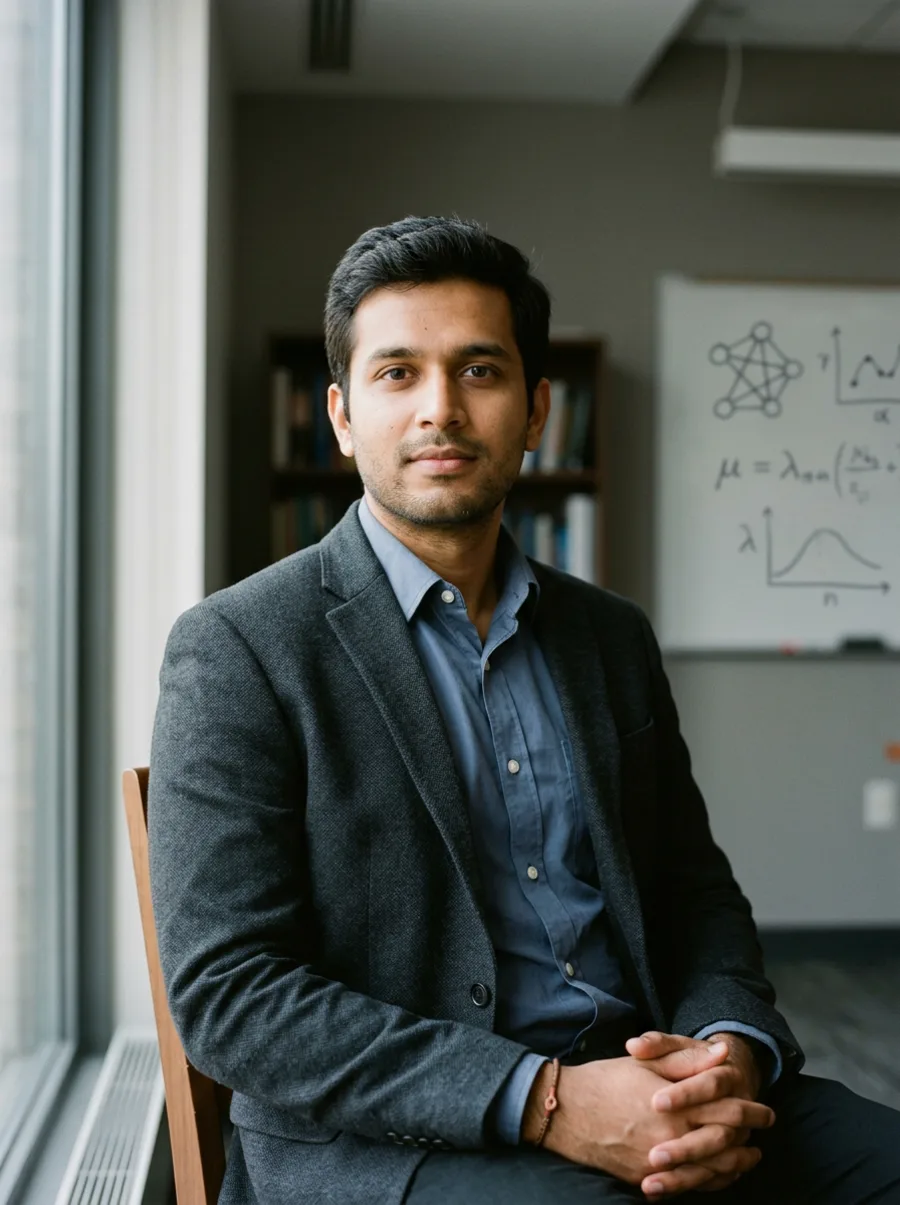
Portrait of Prof. Kwame Osei Academic Leadership

Academic Leadership

Prof. Kwame Osei, PhD, FGA

Professor of Public Health & Dean of Research

PhD in Epidemiology

Institution

University of Ghana

Location

Accra, Ghana

Published

August 28, 2026

Publication ID

ATR-2026-00471

Credential status

Verified

01 · Introduction

Academic journey

Kwame Osei has spent thirty years on a single institutional argument: that epidemiological capacity must be resident rather than visiting. He trained in medicine at Legon, took a doctorate in epidemiology, and returned to a department that at the time sent most of its data abroad for analysis.

He set about changing that, largely through the unglamorous work of building a laboratory, a data unit and a doctoral programme in sequence. The programme has now produced sixty-three graduates, the majority of whom have remained in West African institutions — a retention figure he cites more readily than his own publication count.

His research contribution has been in the design of surveillance systems suited to health systems with intermittent connectivity and limited laboratory throughput. The methods are deliberately modest in their data requirements, a design choice that has drawn criticism from reviewers accustomed to richer settings and gratitude from ministries that have to operate them.

As Dean of Research he has overseen the establishment of a regional data-sharing framework across four countries.


Capacity that depends on a visiting team is not capacity. It is a service — and services can be withdrawn. — Prof. Kwame Osei · On building durable national research infrastructure
02 · Qualifications

Academic credentials

1998

PhD in Epidemiology

Infectious disease surveillance

University of Ghana · Ghana

1993

MPH Public Health

Epidemiology

London School of Hygiene & Tropical Medicine · United Kingdom

1989

MB ChB Medicine

University of Ghana · Ghana

03 · Research

Doctoral research

Research title

Designing Epidemiological Surveillance for Constrained Health Systems

Abstract

The research programme develops and evaluates outbreak-detection methods designed to operate under the data conditions typical of health systems with intermittent reporting, limited laboratory confirmation and substantial missingness.

Problem statement

Standard outbreak-detection algorithms assume timely, complete and laboratory-confirmed case reporting. Where these assumptions fail, the algorithms either miss events or generate alerts at a rate that destroys their operational credibility.

Research methodology

A design-and-evaluation programme combining retrospective analysis of eleven years of national surveillance data, simulation under varied missingness regimes, and prospective operational deployment across sixty-four district health facilities.

Major findings

Detection methods incorporating explicit reporting-delay models achieved materially better sensitivity at fixed false-alarm rates than standard approaches under realistic missingness. Operational deployment reduced median time-to-alert by nine days relative to the previous system.

Academic contribution

The work provides a validated family of surveillance methods designed for, rather than adapted to, constrained reporting environments.

Future applications

The protocols are in national use in four countries and form the technical basis of a regional data-sharing framework.

Department
School of Public Health
University
University of Ghana
Completion year
1998
04 · Bibliography

Publications

4 works recorded on this profile, as provided or externally referenced.

01

Journal Article

Reporting-delay models improve outbreak detection under incomplete surveillance

Osei, K., Adjei, M., Nyarko, F.

The Lancet Global Health, 2022, Vol. 10, No. 7, pp. e988–e997

02

Journal Article

Operational evaluation of district-level surveillance across sixty-four facilities

Osei, K., Mensah, A.

Bulletin of the World Health Organization, 2020, Vol. 98, No. 3, pp. 176–188

03

Research Report

A regional framework for epidemiological data sharing

Osei, K., et al.

West African Health Research Consortium, 2023, pp. 1–140

04

Book

Surveillance in Practice: Epidemiology for Constrained Systems

Osei, K.

Oxford University Press, 2021, pp. 356 pp.

05 · Recognition

Achievements & recognitions

Leadership Position

Dean of Research

University of Ghana · 2018 · Ghana

Institutional responsibility for research strategy and doctoral training.

Honorary Recognition

Fellow, Ghana Academy of Arts and Sciences

Ghana Academy of Arts and Sciences · 2016 · Ghana

Elected fellowship recognising contribution to public health research.

Research Grant

Lead Investigator, Regional Surveillance Consortium

African Union Research Fund · 2019 · Regional

Multi-country programme establishing shared epidemiological data infrastructure.

Academic Award

Public Health Impact Award

West African Health Organisation · 2021 · Regional

Recognising the operational adoption of surveillance protocols across four national systems.

Leadership Position

Founder, Doctoral Programme in Epidemiology

University of Ghana · 2004 · Ghana

Established the programme; 63 graduates to date.

06 · Measures

Research impact

Figures as submitted or externally referenced at the time of publication. Bibliometric measures vary between indexing services and should be read as indicative rather than definitive.

6,210

Citations

38

h-index

141

Research Papers

63

Students Supervised

34

Research Projects

52

Collaborating Institutions

21

Countries Collaborated

07 · Practice

Career & professional journey

2018 — Present

Professor of Public Health & Dean of Research

University of Ghana

Accra, Ghana

Institutional responsibility for research strategy; continues to lead the surveillance group.

2009 — 2018

Professor of Epidemiology

University of Ghana

Accra, Ghana

Founded and directed the doctoral programme in epidemiology.

1999 — 2004

Regional Epidemiologist

Ghana Health Service

Kumasi, Ghana

Field epidemiology and district surveillance implementation.

08 · Consequence

Impact & contribution

Osei's principal contribution is infrastructural. The doctoral programme he founded has supplied epidemiologists to health ministries and universities across the region, and the surveillance protocols developed by his group are in operational use in four national systems. During two regional outbreaks his unit produced the primary situational analyses used by national response teams — analyses that in earlier decades would have been produced elsewhere. He has consistently declined to characterise this as capacity-building, preferring the term capacity-retention.

11 · Verification

Credentials & references

ORCID ↗

0000-0000-0000-0002

Verified
Externally Referenced

Basis of this record

Editorial verification has been completed for the credentials listed on this profile. Corrections and updates may be requested at any time via our corrections page.

12 · Record

Publication record

Originally published
August 28, 2026
Last updated
August 28, 2026
Category
Academic Leadership
Reference ID
ATR-2026-00471

Editorial review confirms completeness, internal consistency and the presence of supporting references. It is not academic peer review, and the Review does not assess the scientific merit of research described on this profile.

Update history

August 28, 2026

Profile originally published.

13 · Citation

Cite this profile

Continue reading

Explore similar profiles

Selected on the basis of research field, institution, qualification and country.

All profiles
The Aeternum Dispatch

New profiles and research writing, once a month

A short editorial letter listing newly published profiles and the research pieces accompanying them. No advertising, no third-party sharing.

By subscribing you agree to our privacy notice.